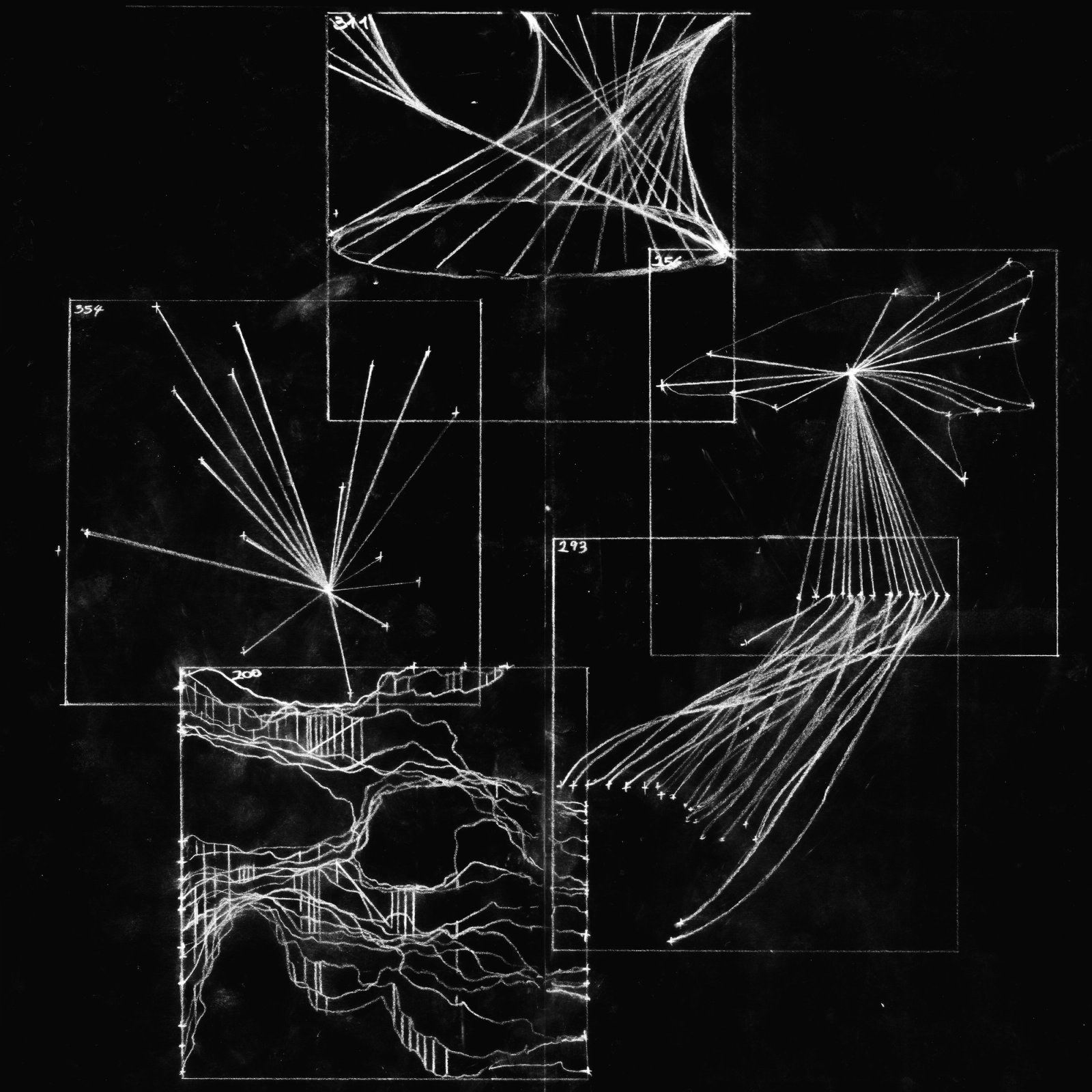
TIME 02 'dm studies 000 - 004' by Daito Manabe
July 10, 2026 - the first official music release from Daito Manabe. A five track EP of avant-garde electronic compositions celebrating chaos and order, humanity and process. Daito's progressive pieces explore the intersection of classical mathematical principles and beautifully crafted, kinetic sound design. Inspired by the synthesis of club music, this EP explores and expands what electronic music can be. Photography & interview: Nosaj Thing
NT: I first discovered your work around 2010 while researching ideas for my first audio visual performances. At the time, I was deep in the LA beat scene playing Low End Theory every week. I remember being surprised when you responded on Twitter saying you already knew my music. What were you hearing or seeing from that scene at the time?
DM: Back then, most of what I discovered came from radio shows, podcasts, and recordings circulating online. I listened to the XLR8R Podcast, Mary Anne Hobbs’ BBC Radio shows, the Low End Theory Podcast, and all kinds of recordings people had uploaded. It was an incredibly exciting period. Dubstep was emerging, the LA beat scene was exploding, and those worlds were beginning to connect with the European electronic music scene. Looking back, it really was a remarkably rich time for music.
At the same time, I was traveling to Europe almost every year to perform live or DJ at festivals like Sónar, so I was constantly discovering new artists in person as well. It was a unique moment where digging through recordings online and experiencing those artists live in clubs and festivals naturally fed into each other.
NT: I remember the first time I visited your studio, you had every MPC sampler and I think doubles of almost every J Dilla record. At that moment I knew we were probably going to become good friends. Where did your relationship with hip hop begin?
DM: My first encounter with hip hop was watching MTV Rap at home when I was in junior high school, around 1990. Until then I had grown up listening to classical music and jazz, but the culture of sampling and scratching completely changed the way I thought about music.
When I entered high school, I bought my first turntables and mixer. I practiced juggling records and scratching using two copies of the same hip hop record, and eventually started entering DJ competitions and scratch showcases. After that, I was DJing about five nights a week. In those days I could only play hip hop when the club was relatively empty. Once people started filling the dance floor, I had to switch to R&B, reggae, or disco classics.
Around that time I bought an MPC2000 and an SP1200 and started making beats. At the same time I became friends with a group of jazz musicians and formed a band with them. I was responsible for the beats and scratching, and we eventually released an album through Tokuma Japan. I spent almost every day in the studio recording with Pro Tools.
What I found fascinating was how interested those jazz musicians became in hip hop. I spent a lot of time explaining sampling as a musical language and why producers like DJ Premier and J Dilla were so revolutionary. They started writing music influenced by those ideas, while I contributed beats and scratching to the band. I continued working that way throughout my early twenties. Our bandleader, Mr. Shiina, was a very important mentor for me during that period. I had also become quite proficient with Max. I started building my own granular synthesis patches and sound processing tools and incorporating them into live performances.
At the same time, I became completely obsessed with digging for sample sources. Around 1995, I even built my own website documenting original samples. I spent countless hours researching source material online and buying records, especially records sampled by DJ Premier, J Dilla, Beat Rock, DITC, and many others.
Back then, online information was still far from complete, so I also learned a tremendous amount from the staff at Sound Library, the legendary record store in New York’s East Village. There were many days when I spent the entire day digging through records from morning until night. Looking back, I think I spent almost all of my money on records.
When I look back now, hip hop wasn’t simply a genre of music that I loved. It became the foundation for almost everything I do today: DJing, record digging, beat making, collaborating with jazz musicians, programming, and eventually creating interactive audiovisual works."
NT: I think moments like that changed my perception of your work because I realized underneath all the technology was someone deeply obsessed with music. Do you think people sometimes overlook that side of your work?
DM: Both of my parents are musicians, so I grew up surrounded by instruments and synthesizers, and I started taking piano lessons when I was very young. My grandfather was an avid record collector and an audiophile, so I was incredibly fortunate to grow up in such a rich musical environment. At university I tried composing in the traditional sense by writing musical notation, but it never really suited me. My way of making music was always through sampling, recording musicians, editing performances, and assembling ideas in the studio.
When I began to feel the limitations of that approach, I discovered Max. It introduced me to the idea of algorithmic composition, and that fundamentally changed the way I thought about making music. That eventually became the foundation of my creative practice.
Even today, I still think of myself less as a traditional composer and more as an extension of a DJ or a sound designer. I know composers who rarely listen to other people’s music, but I’m the opposite. I’m constantly listening, constantly digging for new music. That mindset is still deeply rooted in DJ culture.
For many years I simply described myself as a DJ and producer. Then one day Alva Noto was trying one of the plugins I had developed, and he said, “This is composition. You shouldn’t call yourself a DJ. You should call yourself a composer.” That conversation was what eventually made me start using the title “Composer.”
Even so, if I’m honest, “DJ” or “Producer” still feels like the most natural description of who I am.
NT: Our first collaboration became the 'Eclipse / Blue' video in 2012 with Kazu Makino. Looking back now, what do you remember most about that period creatively?
DM: At that time I had done very few music videos. Most of my work focused on creating visuals that existed in real time rather than relying heavily on editing. YouTube was also a very different place then. There was still a strong DIY culture around one-take performances, real-time experimentation, and showing how things were made behind the scenes. I was much more interested in capturing something that happened live than carefully constructing something through editing. That approach felt much closer to live performance or documentary filmmaking.
When I first heard the demo for 'Eclipse / Blue', the lyrics and atmosphere immediately made me think about the mechanics of a lunar eclipse. I started wondering if I could recreate that phenomenon using nothing more than a projector, a screen, and a dancer. The idea was to project light onto the dancer so that the silhouette cast onto the screen became part of the composition. That relationship between light, shadow, and the human body felt perfectly connected to the song.
There was originally a deadline, of course, but Jason told me, “Take as much time as you need until you’re happy with it.” We ended up going well beyond the original schedule, but that freedom allowed me to fully explore the idea without compromise.
In the end, it became one of my earliest signature works, and it’s still one of the projects I’m most emotionally attached to.
Produced by Daito Manabe
Written by Daito Manabe, CELES A., Sinan Bokesoy(sonicPlanet), Kythex
Mastered by Beau Thomas
Art direction and design by Riomar McCartney (upcoming.studio)
Creative direction by Timetable